Mattress Cleaning That Respects What a Mattress Is
Layers of foam under a quilted cover, with no way to drain and no airflow underneath. The right amount of moisture in a mattress is almost none, and that's how we clean them.
Mattress cleaning is a health service before it's a cosmetic one. Nobody sees the ticking under a fitted sheet, so pretty was never the point. What matters is pulling out the accumulated skin, sweat residue, dust mite load, and allergens you press your face against for eight hours a night. Done right, it's also the one cleaning job where restraint with moisture matters more than anywhere else in the house.
Baking soda, shampooers, and other bedroom mistakes
The internet's favorite mattress trick is a snowfall of baking soda, a waiting period, and a vacuum. The vacuum gets the powder sitting on top. It does not get the powder that sifted through the quilted ticking into the fiber batting below, where it stays forever as a gritty layer your body grinds against the fabric every night. Baking soda also doesn't neutralize the oils and proteins causing mattress odor. It masks lightly, briefly, and leaves mineral grit as its legacy.
The more destructive move is borrowing a carpet shampooer. A mattress accepts water without complaint, which is the trap. The top foam layer drinks whatever the machine pushes in, the fitted sheet goes back on, and that moisture is now sealed inside a foam sandwich with no airflow above or below. Give it a week and the bed has a sour note that wasn't there before. That's microbial growth in foam that never dried, and there's no reaching it afterward.
Then there's the stain-bleaching route: hydrogen peroxide or diluted bleach poured on a yellowed patch. Sometimes the yellow lightens. The ticking dye usually lightens too, so the stain becomes a pale ghost with a bleached border, more visible than the original in side light. And the moisture problem from the paragraph above still applies, because pouring is saturating.
A mattress has no drainage and no airflow. Whatever soaks past the ticking stays, which is why the right amount of moisture in a mattress is barely any at all.
Why saturation is the enemy in bedding
A mattress is upholstery with nowhere to go. Quilted ticking on top, then fiber batting, then progressively denser layers of foam or foam-wrapped springs. Every layer is absorbent, none of them drains, and in use the whole assembly is capped by sheets and pressed against a solid foundation. Furniture cushions at least sit in open air. A mattress spends its life sealed, which is why any moisture that gets past the ticking is a resident, not a visitor.
What builds up in it is mostly you. A sleeping adult sheds skin cells all night and puts off close to half a liter of moisture, every night, for years. The moisture carries salts and body oils into the top layers and evaporates, leaving them behind. The shed skin feeds dust mites, which colonize the top inch of a mattress more densely than anywhere else in a home. The mites themselves are harmless. Their waste is one of the most common allergy and asthma triggers there is, and it's concentrated where your face is.
This is why the yellowed zones on an older mattress sit where shoulders and hips lie. That's sweat residue, oxidized over time, in the exact map of how you sleep. It's also why a mattress can pass a casual smell test in a made bed and still carry a real odor load an inch below the surface.
Surface-level chemistry, immediate recovery
Our process is built around the sealed-sandwich problem: everything happens at the surface, and nothing is given the chance to travel deeper. The low-moisture carbonated solution goes on in a metered film, lifts the skin residue, oils, and allergen load out of the ticking and upper batting, and the extraction pass recovers it right away, moisture included. The foam layers below stay dry because the moisture never exists in a quantity that could reach them.
Where a mattress has odor from pet accidents or years of use, we apply an enzyme treatment that breaks the odor source down at the molecular level. No perfume, no cover scent, because a fragrance layered over a source just makes a third smell.
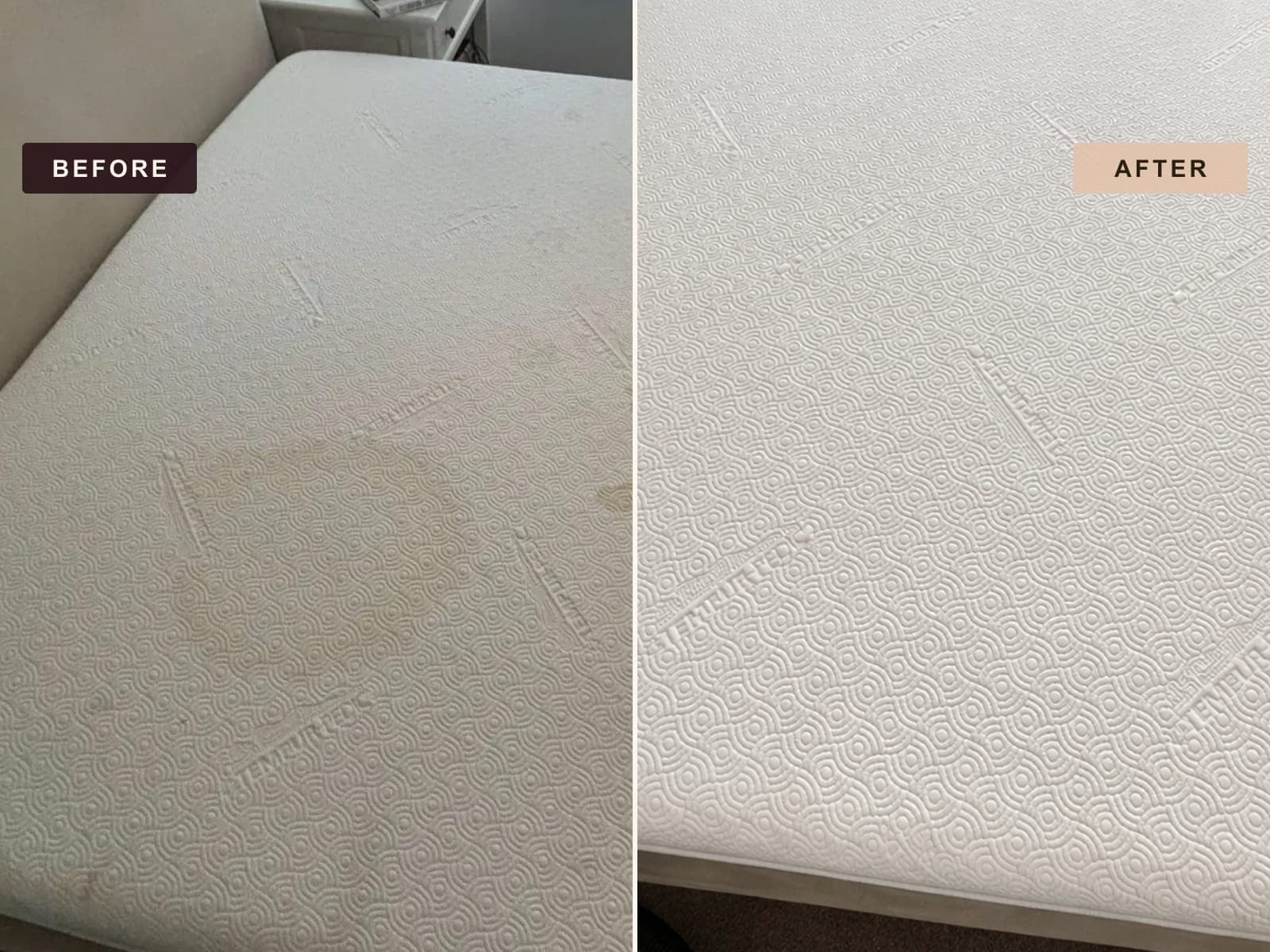
Established yellow staining is oxidized, and oxidation is a one-way chemical change. Deep-set sweat stains usually lighten but often don't vanish, and old urine marks that were never treated may be permanent even after the odor itself is gone. We'll tell you what we expect before we start, and the mattress is dry and sleepable the same night, one to two hours after we finish.
We walk through the full low-moisture process on our how rug and upholstery cleaning works page, and every job is backed by our 100% satisfaction guarantee.
Frequently asked questions
Will the yellow stains come out?
Expect them to lighten, and don't expect them to disappear. Yellowing is sweat and body oil that has oxidized in the fabric, and oxidation can't be reversed by any cleaning. What we remove completely is the active layer: the skin residue, oils, allergens, and odor sources. The mattress gets genuinely clean even where its history stays faintly visible, and we'll give you a straight read on yours before starting.
Can I sleep on it tonight?
Yes. The process leaves so little moisture behind that the surface is dry in one to two hours. An afternoon appointment has you making the bed before bedtime, with fresh sheets onto a genuinely clean mattress.
Does this actually help with allergies?
It removes the load that triggers them: dust mite waste, dander, and shed skin concentrated in the top layers where you breathe all night. Allergists routinely point at the bed first for morning congestion. Cleaning doesn't make a bedroom sterile, but pulling years of accumulated allergen out of the surface you sleep on is the single biggest change you can make to it.
How often should a mattress be cleaned, and what does it cost?
Every 12 to 18 months for most people, annually if allergies, asthma, or a bed-sharing pet are in the picture. On cost, the technician quotes a firm price at the walkthrough based on size and condition, and there's $25 off when you mention the website.
Related rug & upholstery problems we solve
Pet hair & odor
Hair fastened into the weave, dander driving the allergies, rancid coat oils behind the smell. All three, out.
UpholsteryCareStain removal
Tannins, oils, proteins, and dyes each release differently. Matched chemistry, controlled moisture, honest odds.
UpholsteryPieceCouches & sofas
The head service. Sofas cleaned in your living room, one cushion at a time, dry the same afternoon.
Sit back down on clean
Enter your zip code to reach your local Safe-Dry® team. We clean rugs and upholstery in-home across 532 locations in 6 states, with same-day appointments in most areas.