Pet Hair, Dander, and Odor in Your Furniture
Three separate problems wearing one fur coat. The hair you can see, the dander you can't, and the oil film behind the smell. Each one needs its own removal.
Why sprays and rollers lose this fight
The fragrance spray is the big one. A couch that smells like dog gets misted with something floral, and for an hour the room smells like a dog wearing perfume, because that's exactly what has happened. The scent molecules ride on top of the odor source without touching it, then evaporate first, and the original smell walks back into the room. Some cover sprays make it worse long-term by adding their own oily carriers to the fabric, feeding the very film that's producing the odor.
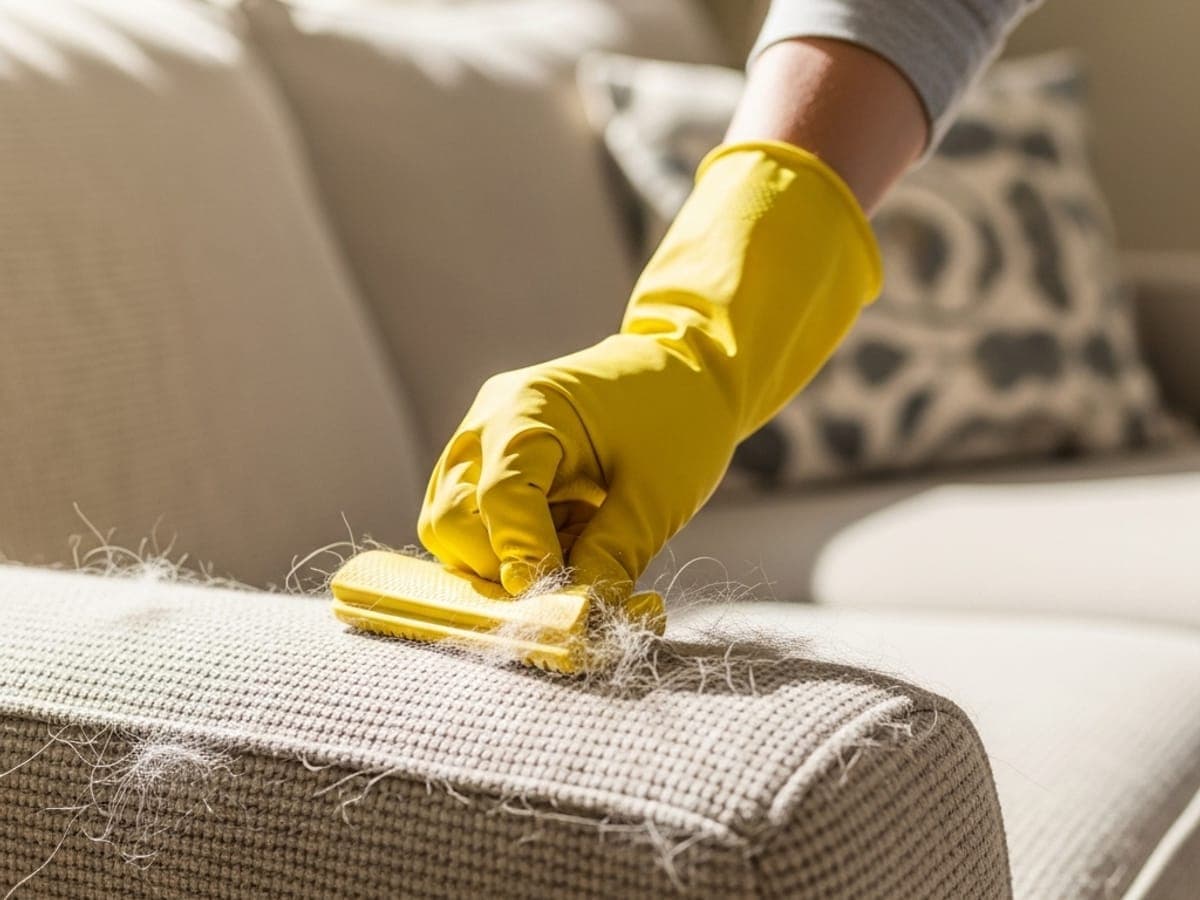
Lint rollers, rubber gloves, and vacuum passes all work, up to a point, and the point is the surface. They harvest the loose hair lying on top of the fabric and leave the population that has worked down into the weave, which on a pet's favorite cushion is the majority. People roll a cushion clean, watch hair reappear by evening, and conclude their pet sheds supernaturally. The evening hair was already in the cushion, migrating up.
The last trap is washing only the removable covers. The covers come back from the laundry perfect, then get zipped back over cushion cores that still hold the hair, the dander, and most of the odor. Two weeks later the covers have re-absorbed everything the cores were storing, and the owner concludes washing doesn't work. It worked fine. It just treated a quarter of the problem.
Hair hooks in, dander floats, oil goes rancid
Pet hair doesn't lie on fabric, it fastens to it. Each hair carries microscopic scales along its shaft, and woven upholstery is a field of loops and crossings for those scales to catch on. Every time a body shifts on the cushion, pressure and friction ratchet the caught hairs deeper, the same one-way mechanics that felts wool. This is why embedded hair ignores a vacuum that would strip it easily off a hard floor: by then the hair has ratcheted in past the reach of suction.
Dander is the invisible passenger and the one that matters medically. It's microscopic flakes of shed skin carrying dried saliva and skin proteins, and those proteins, not the hair, are what pet-allergic people react to. Dander is light enough to go airborne every time someone sits down, then settles back into the same fabric that launched it. A sofa a pet has used for years is a dander reservoir that keeps a room's allergen level topped up no matter how often the floors get cleaned.
The smell is a third mechanism entirely. A pet's coat is oiled by its skin, and that oil, sebum, transfers to fabric at every contact, concentrating wherever the animal habitually lies. You can usually find the spot by eye: a subtly darker patch shaped like a sleeping dog. Fresh sebum barely smells. Aged sebum oxidizes, going rancid the way any oil does, and that rancid note is the doggy smell that survives every spray in the cabinet. It survives because the source is an oil bonded to the fabric, and fragrance doesn't move oil.
Extract the load, break down the source
The mechanical load comes out first. Extraction pulls the fastened hair and the settled dander up out of the weave, working cushion by cushion, seams and crevices included, since seams are where hair density peaks. This pass alone changes the room for allergy sufferers, because it removes the reservoir that has been re-seeding the air.
The oil film gets the carbonated treatment. The low-moisture solution floats the bonded sebum layer off the fibers, extraction carries it away with the moisture, and the darker lying-spot patch generally lifts with it. Then odor gets treated as chemistry, with an enzyme product that breaks the odor-causing compounds apart at the source. Nothing is perfumed, nothing is masked. When the source is gone the smell has nothing to come back from, and the piece is dry in one to two hours.
One boundary worth stating: this service handles the hair, dander, and coat-oil odor that comes from a pet living on the furniture. Furniture a pet has urinated on repeatedly is a different problem, because urine penetrates into cushion foam where surface processes don't reach, and if that's what we find, we'll say so before anyone pays for a cleaning that can't fix it.
We walk through the full low-moisture process on our how rug and upholstery cleaning works page, and every job is backed by our 100% satisfaction guarantee.
Frequently asked questions
Will cleaning the couch actually help my allergies?
If the allergy is to the pet, very likely, because the reaction is to dander proteins and the sofa your pet lives on is the biggest dander reservoir in the room. Removing that stored load, instead of just the visible hair, is what drops the allergen level. Households with allergic members and resident pets are the clearest case we know of for annual cleaning instead of the usual 12 to 18 months.
Why does the couch smell like dog again a week after I spray it?
Because the spray never touched the source. The smell comes from coat oils that transferred to the fabric and oxidized, and a fragrance sits on top of that oil film until the fragrance evaporates, which takes days at most. Removing the film and breaking down the odor compounds with enzymes is what makes the change permanent instead of weekly.
Can you really get the embedded hair out?
The overwhelming majority, yes. Hair fastens into fabric by its scales and works deeper with use, which is why home tools only skim the surface layer. Professional extraction reaches the fastened population. On loose weaves and boucle-style fabrics a few of the deepest hairs can survive even that, so we'll say the honest version: expect a dramatic difference, not a laboratory-grade zero.
My pet has had a few accidents on the cushions. Is this the right service?
Depends how far the urine went. A surface-caught accident cleans up within this service, with enzyme treatment on the spot. Urine that soaked into the cushion foam repeatedly is beyond any surface process, ours included, and we'll tell you so at the walkthrough instead of taking the job and leaving you with the smell.
Related rug & upholstery problems we solve
Mattresses
Dust mites, sweat residue, and eight hours a night of your face against it. Cleaned without ever soaking the foam.
RugCareRug odor removal
Odor lives in the backing, not the pile. Enzyme treatment breaks it down at the source, no fragrance involved.
UpholsteryCareClean or replace?
Press test, towel test, smell test. Ten minutes that decide whether the couch needs us or the curb.
Sit back down on clean
Enter your zip code to reach your local Safe-Dry® team. We clean rugs and upholstery in-home across 532 locations in 6 states, with same-day appointments in most areas.