Getting Stains Out of Upholstery
Wine, coffee, grease, ink, mystery spots. What comes out, what doesn't, and why the couch rings where the carpet never did.
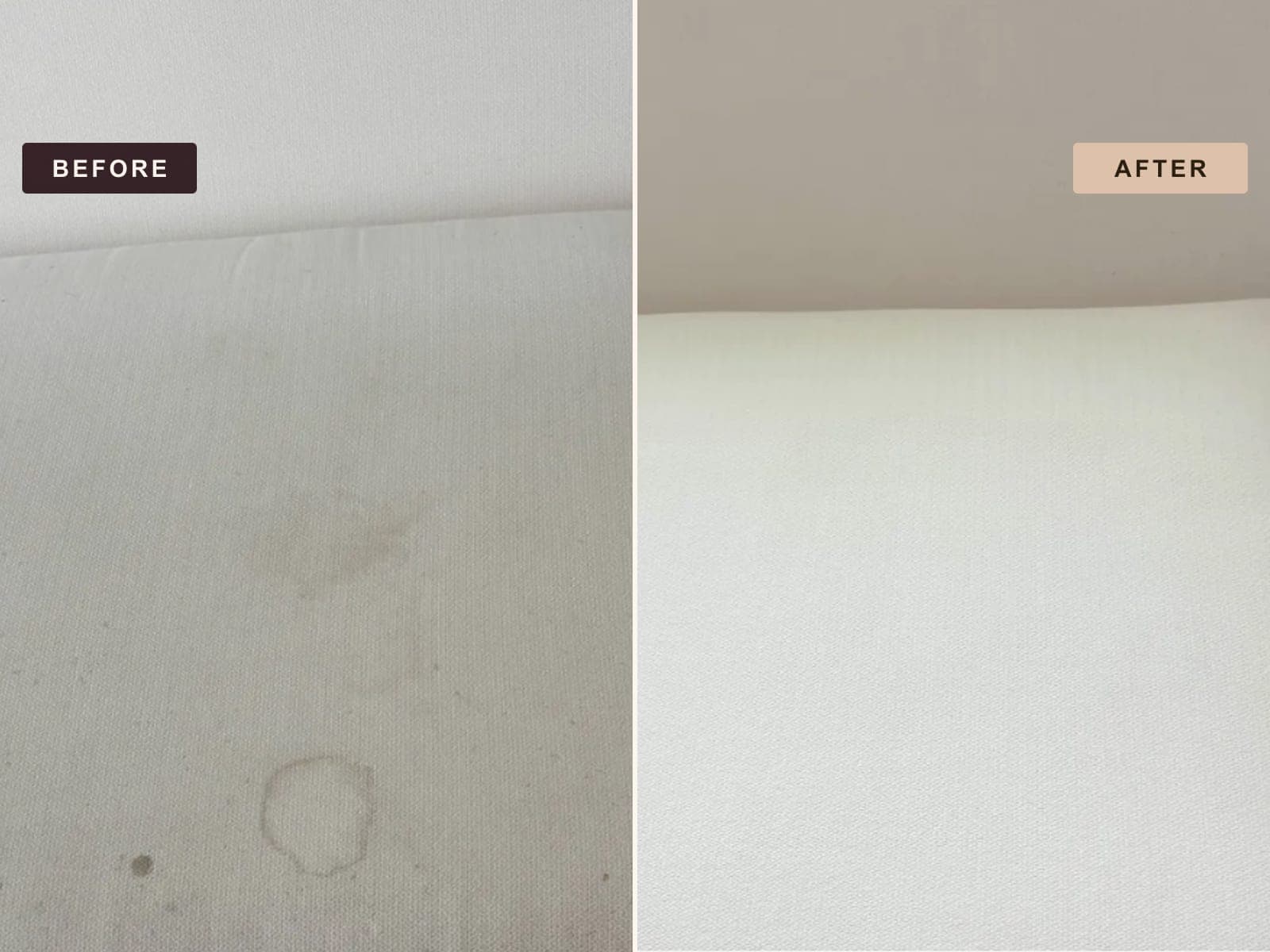
Stain removal on furniture is a harder discipline than stain removal on carpet, and the people who learn that usually learn it from a ring. The same blot-and-dab routine that works fine on a carpeted floor leaves a halo on a sofa cushion, and understanding why is the difference between a fixable spot and a permanent one. This page covers what actually happens when fabric stains, what we can get out, and what can't be gotten out no matter who does the work.
How home attempts turn a spot into a feature
The first instinct is rubbing, and rubbing is the most reliable way to make a stain permanent. Pressure drives the staining material off the fiber surface, where it's removable, and into the fiber interior, where much less is. It also abrades the yarn face, so even a successfully rubbed-out stain leaves behind a patch of frayed fiber that catches light differently forever. Blotting lifts. Rubbing installs.
The second instinct is the oxygenated miracle powder or the peroxide bottle, and the real risk there is the fabric dye around the stain. Oxidizers can't tell a wine molecule from a dye molecule, so the aggressive treatment that lightens the stain often lightens its neighborhood too, leaving a pale halo that reads worse than the original spot. Bleached fabric is permanent in the truest sense: nothing puts that dye back.
The third mistake is volume. A stubborn spot invites more product and more water, and on upholstery every extra ounce raises the odds of the moisture spreading past the visible spot, wicking through the fabric plane, and drying into a ring wider than the whole cleaning attempt. A spot that got one careful treatment can be rescued. A spot that survived four escalating attacks arrives pre-set, pre-spread, and pre-bleached, and there's less left for anyone to save.
Why furniture rings when carpet forgives
Carpet gets away with sloppy stain work for structural reasons. It has deep pile to hide residue in, a pad below to accept excess moisture, and a floor under that. Upholstery fabric has none of that grace. It's a thin textile sheet stretched over foam, and the foam changes everything about how liquid behaves.
When a spill hits a cushion, gravity takes some of it down into the foam. But foam doesn't wick the way a carpet pad does: it holds. Then, as the surface dries and moisture is drawn back upward by evaporation, everything dissolved in that held liquid rides the elevator up and redeposits at the fabric face. This is wick-back, and it's why a spot cleaned beautifully on Saturday reappears on Wednesday. The stain wasn't cleaned. It was relocated downstairs, and it commuted back.
The ring mechanism is lateral. In a thin fabric, moisture doesn't just go down, it travels sideways through the weave, and it keeps traveling until it reaches its outer limit and evaporates there. Whatever it dissolved along the way, spill residue, old soil, fabric finishes, gets carried to that boundary and deposited in a concentrated line. Carpet does this too, but pile depth swallows the evidence. On the flat face of a sofa cushion, the line sits in plain view, which is why furniture haloes and carpet rarely seems to.
And underneath all of it is the fact that stains aren't one thing. Coffee and wine are tannins. Grease and lipstick are oils. Milk and blood are proteins. Ink and dye transfer are colorants. Each family bonds to fiber by a different mechanism and releases under different chemistry, which is why one all-purpose spray leaves such an uneven record. The right chemistry on the wrong stain does nothing. The wrong chemistry on the wrong stain does damage.
Chemistry matched to the stain, moisture kept on a leash
We start by identifying what the stain is and what the fabric is, because those two answers pick the chemistry. Tannin, oil, protein, and dye each get their own approach, tested in a hidden area on anything delicate, applied at the spot in controlled amounts. The low-moisture carbonated process then works the loosened material to the surface and the extraction pass removes it, moisture included, before wicking or edge-drying can organize a comeback. No ring forms because no wandering wet edge ever exists, and nothing wicks back because nothing was left in the foam to return.
Now the part better said here than at your door. Ink is often permanent. Dye transfer from jeans or a throw blanket usually is too, because the fabric has effectively been dyed a second color. Old stains that were heat-set by a dryer, an iron, or repeated hot-water attempts may be locked in. Sun fading isn't a stain at all and no cleaning touches it. We'll tell you at the walkthrough which category your spot is in, and we won't charge you for chasing something we know is gone. Most spots people live with for years, the coffee, the food, the who-knows, come out or fade to invisible. The unfixable list is real but shorter than people fear.
We walk through the full low-moisture process on our how rug and upholstery cleaning works page, and every job is backed by our 100% satisfaction guarantee.
Want to try it yourself first?
Light, everyday soiling is worth a shot at home. Here is the honest version of what actually helps, and the point where DIY hits its ceiling.
- 1
Act inside the first minutes
A fresh spill is a surface event. An hour-old spill has bonded and traveled. Get to it while it's still sitting on top and half the battle never happens.
- 2
Blot straight down with a white cloth
White so you can see what's transferring, straight down so nothing spreads. Press, lift, move to a clean section of cloth, repeat. Keep going as long as color keeps coming up. No circles, no back-and-forth, no pressure sliding.
- 3
Use cool water, sparingly, from the outside in
Lightly dampen the cloth, work from the spot's edge toward its center, and blot dry as you go. The goal is to keep the wetted area no bigger than the stain. Skip this step entirely on anything with an S or X care tag.
- 4
Stop after one honest attempt
If a gentle pass with water didn't move it, the stain needs chemistry matched to what it is, and repeated generic attempts are how stains get set, spread, and bleached. One try, then hands off.
- 5
Leave these alone from the start
Ink, anything red, grease, and anything on velvet, silk, or an unknown fabric. These are the categories where the first wrong move closes the door, and they're the ones worth a phone call instead of an experiment.
Frequently asked questions
Why did the stain come back a few days after I cleaned it?
Wick-back. Part of the spill went down into the cushion foam, and foam holds what it takes. As the surface dried, evaporation pulled that held liquid upward and it redeposited the stain at the fabric face. The fix is removing what's in the foam, which is what our extraction pass does and a surface wipe never can.
Why is there now a ring bigger than the original spill?
The moisture from the cleaning attempt traveled sideways through the fabric, dissolving soil and finishes as it went, and dropped all of it at the edge where it finally evaporated. That deposit line is the ring. It's a moisture-control failure, not a soil problem, and it's preventable and usually reversible with a controlled full-panel cleaning.
Which stains can't you remove?
Ink is frequently permanent. Dye transfer from denim or colored throws usually is, since the fabric has genuinely been re-dyed. Heat-set stains and bleach spots are locked, and sun fading is fiber damage, not a stain, so cleaning can't reach it. Everything else, tannins, food, grease, protein stains, general mystery spots, comes out far more often than people expect, and we'll give you a straight prediction before we start.
Do you guarantee a stain will come out?
No, and be wary of anyone who does before seeing it. What we guarantee is an honest assessment at the walkthrough: what the stain is, what the odds are, and whether it's worth treating. Firm price before any work, $25 off through the site, and no charge for heroics on a stain we've told you is permanent.
Related rug & upholstery problems we solve
Rug stain removal
Wine, coffee, ink, and mystery spots, treated by stain and fiber, with a straight answer on what's permanent.
UpholsteryFabricMicrofiber
The fabric that attracts oil, rejects water, and rings when you clean it wrong. We clean it without the rings.
UpholsteryCareClean or replace?
Press test, towel test, smell test. Ten minutes that decide whether the couch needs us or the curb.
Sit back down on clean
Enter your zip code to reach your local Safe-Dry® team. We clean rugs and upholstery in-home across 532 locations in 6 states, with same-day appointments in most areas.