
Recliner and Armchair Cleaning
The headrest and the armrests carry more concentrated body oil than any spot on any couch. We lift it out in place, and the mechanism underneath never gets wet.
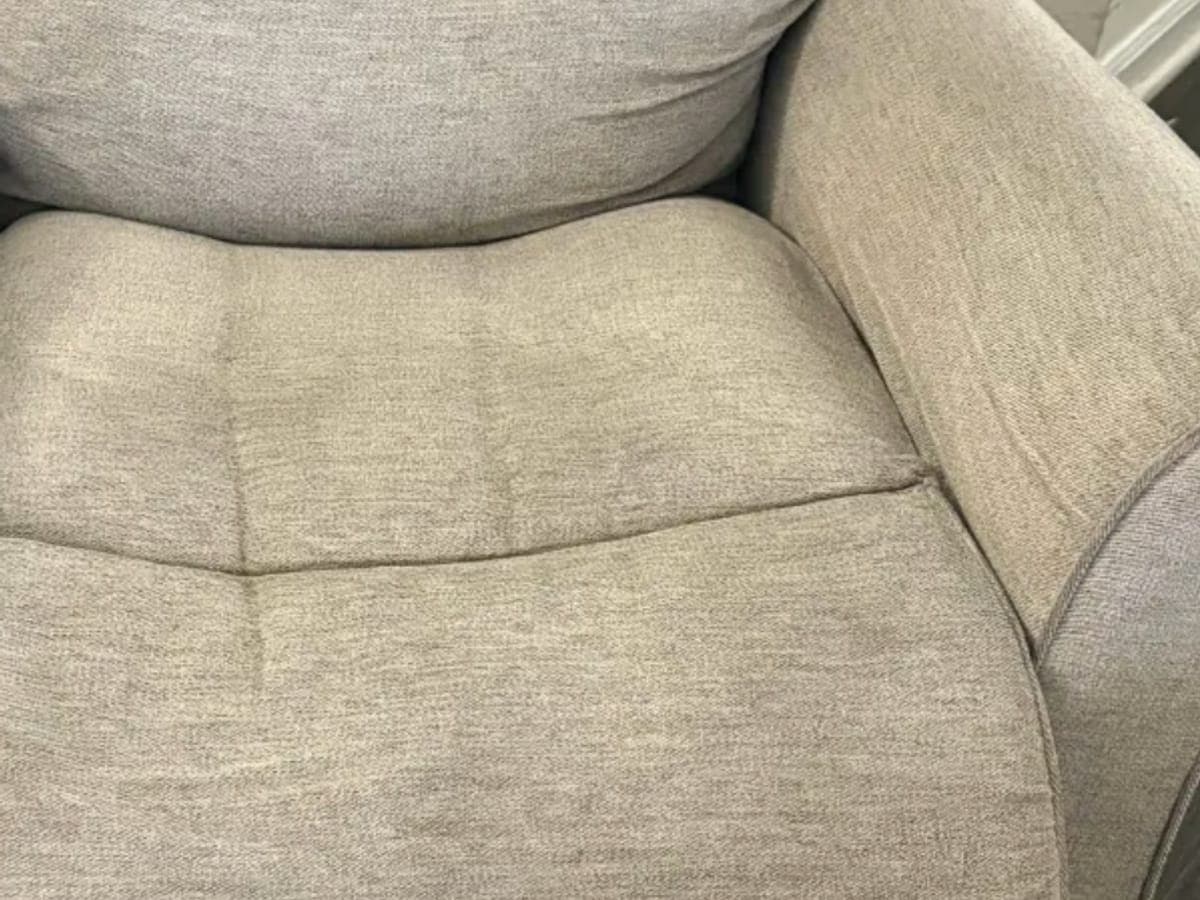
Armchair and recliner cleaning is a different job from couch cleaning, even though the fabric is often the same. A couch spreads its use across a family. A recliner belongs to somebody. That ownership shows up in the fabric as two dark islands, one where a head rests and one under each forearm, and those islands are the whole story of cleaning this kind of chair.
What goes wrong when people spray at it
The usual home attack on a dark headrest is an all-purpose spray and a rag, and it fails twice. First, general cleaners are built for hard surfaces and leave their surfactants behind in fabric, where the residue keeps collecting soil. Second, body oil that has been oxidizing on a headrest for a few years doesn't respond to a light misting. People end up scrubbing, the oil smears wider, and the dark patch gains a fuzzy halo.
Recliners add a mechanical hazard the sprayer can't see. Under the seat is a steel linkage, springs, and pivots, and on power models a motor and wiring. Liquid that soaks through the seat or runs down the footrest gap finds that steel. A recliner that squeaks or grinds a month after an enthusiastic home cleaning usually got its mechanism wet.
Draping the problem is the other route: a throw over the headrest, a cover over the arms. Covers absorb the oil instead, get washed rarely, and meanwhile the chair underneath keeps aging wherever the cover slips. It postpones the reckoning without shrinking it.
One occupant, concentrated deposits
Divide hours of contact by square inches of fabric and the recliner wins by a mile. A family of four spreads its use across an entire sectional. A recliner takes one person, in one position, for hundreds of evenings a year, and the contact points never move. Scalp oil and hair product go into the same six inches of headrest every night. Palm and forearm oil go into the same stretch of each arm. That repetition builds a deposit far denser than anything a shared couch develops.
Scalp oil is also the heaviest soil the human body produces, thicker than palm oil and usually carrying hair product with it. It oxidizes in the fabric, darkens as it ages, and bonds dust on top. That's why a recliner can be nearly new everywhere except a brown-shadowed headrest, and why that shadow laughs at ordinary cleaning attempts. The fabric there isn't worn. It's loaded.
Extra passes where the oil lives
We clean the chair in place with the same low-moisture carbonated process we use on every piece, but the passes aren't even. Headrest and arms get the extra attention, with the solution given the work of floating that dense oil load up to the surface where extraction can take it out with the moisture. Seat, back, wings, and footrest get their turn, and cushions that detach are worked individually on both faces.
Moisture control is what keeps the mechanism safe. Because the solution goes on light and leaves with the extraction pass, nothing runs, drips, or soaks toward the steel. Frame and linkage stay dry, and the fabric itself is dry to the touch in one to two hours, so the chair's owner gets it back the same evening.
Leather recliners get their own routine: a gentle cleaning that lifts the surface oils, then conditioning so the hide stays supple where it flexes. One more thing, because recliners earn it more than most furniture: fabric on a twenty-year-old chair that has actually worn thin, or a headrest where dye has broken down under years of oil, will clean up but won't come back to new. We'll tell you which situation you have before we start.
We walk through the full low-moisture process on our how rug and upholstery cleaning works page, and every job is backed by our 100% satisfaction guarantee.
Frequently asked questions
Is it safe to clean a power recliner?
Yes. The motor, wiring, and linkage are below and behind the upholstery, and our process never puts enough liquid into the fabric for any to migrate down there. Nothing is sprayed toward the mechanism and nothing pools. The chair reclines exactly as it did, just with clean fabric.
Why is the headrest so much darker than the rest of the chair?
Scalp oil. It's the densest oil your body leaves on furniture, it often carries hair product with it, and on a recliner it lands in the same small patch every single evening. It darkens as it oxidizes and glues dust on top of itself. Concentrated deposits like that need professional chemistry, but they're deposits, and deposits come out.
My recliner is leather. Do you handle that?
We do. Leather gets a gentle cleaning that removes the surface oils, followed by conditioning so the hide keeps its flexibility where the chair folds and flexes. What we don't do is re-pigmentation or dye work, so color that has genuinely worn away is beyond a cleaning and we'll say so up front.
How often does a daily-use recliner need this?
Treat it like the hardest-working seat in the house, because it is. Every 12 to 18 months keeps a typical chair ahead of the oil buildup, and annual is the better rhythm if the chair sees hours of use every day or shares its evenings with a pet.
Related rug & upholstery problems we solve
Couches & sofas
The head service. Sofas cleaned in your living room, one cushion at a time, dry the same afternoon.
UpholsteryFabricLeather
Gentle cleaning plus conditioning that lifts the banked oils and keeps the hide from drying and cracking.
UpholsteryCareStain removal
Tannins, oils, proteins, and dyes each release differently. Matched chemistry, controlled moisture, honest odds.
Sit back down on clean
Enter your zip code to reach your local Safe-Dry® team. We clean rugs and upholstery in-home across 532 locations in 6 states, with same-day appointments in most areas.