Getting Stains Out of Rugs, and Knowing Which Won't Come Out
Most spills come out. Some marks are permanent, and we'll tell you which is which before we start, because a stain is sometimes not a stain at all.
The supermarket spray cycle
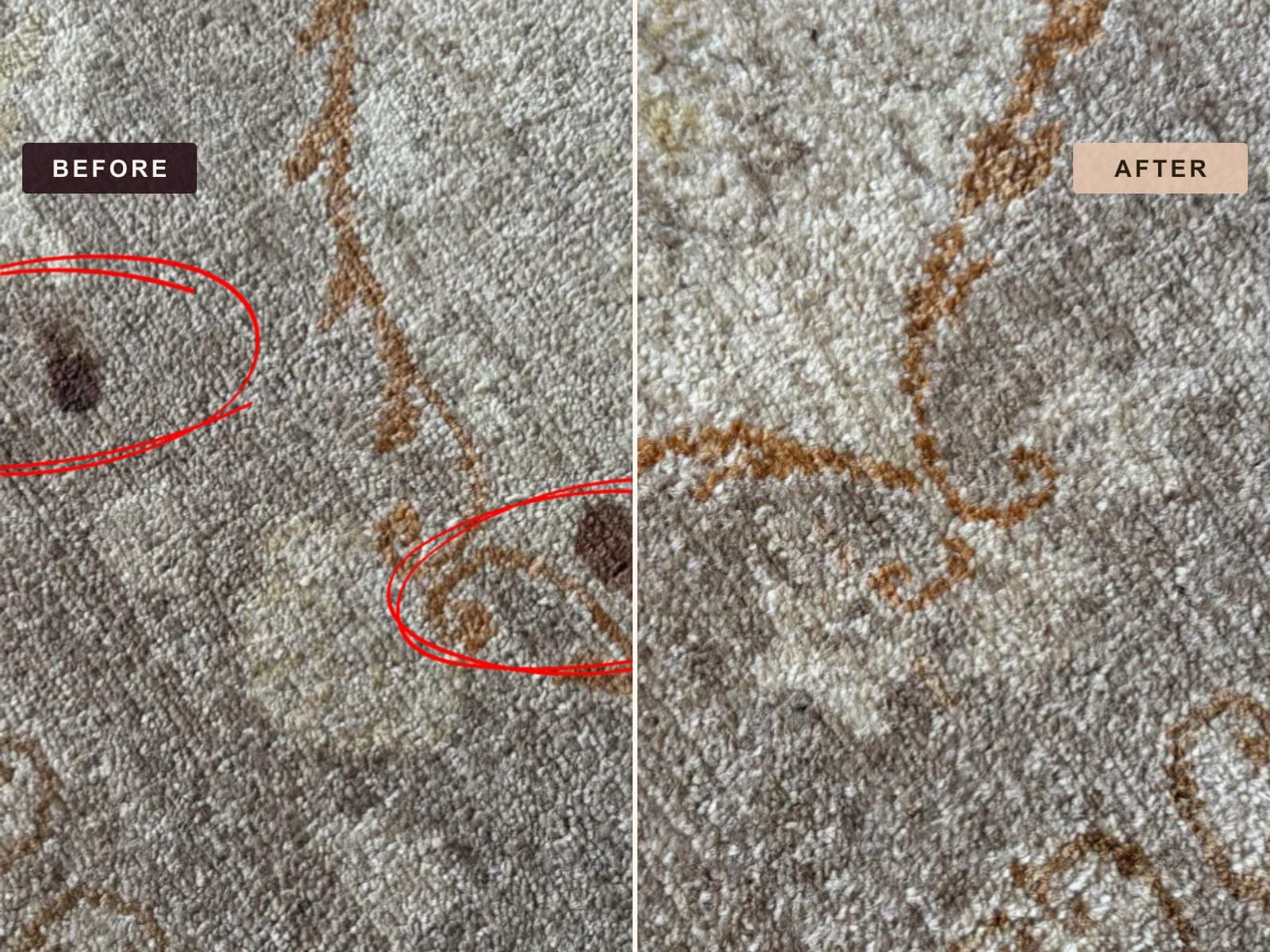
Grocery-store spot sprays are engineered to produce a visible result on the spot you point them at, and they do, twice over. The aggressive surfactants strip the spill along with some of the rug's finish, and the optical brighteners in most formulas leave a patch that reads lighter under daylight. Six months later there's a pale ghost where the stain used to be, which is not the same thing as a clean rug.
Scrubbing is the other reflex, and it does damage no chemistry can undo. Rubbing a spot back and forth frays the tips of the pile, and frayed tips catch light differently than intact ones forever after. Plenty of what people show us as a stubborn stain is actually a scrub mark: the spill left long ago and the texture damage stayed.
Then there are the internet recipes. Vinegar and baking soda mostly neutralize each other and put on a foam show. Hydrogen peroxide genuinely does remove stains, because it's a bleach, and on a colored rug it takes the rug's dye along with the spill. That trade is permanent.
Why stains grab where they do
Here's the chemistry that decides whether a spill becomes a stain. Rug fibers have a finite number of dye sites, the molecular parking spots where color attaches. The mill's dye filled some of them when the rug was made. The empty ones are still open, and they don't care whether the next molecule to arrive comes from a dye house or a glass of Malbec.
That's why the worst offenders are the ones that are dyes themselves. Red wine, coffee, and tea carry tannins. Sports drinks and popsicles carry food coloring. When those hit open dye sites, the rug has been dyed, in a spot, by accident, and removal means breaking a chemical bond instead of lifting soil.
Heat and time both lock the door. A hot spill drives color into fiber faster than a cold one, which is why coffee outranks most other kitchen accidents. And a spill that sits for months oxidizes and bonds in ways a fresh one hasn't yet. The same wine, same rug, same spot is an easy job at one hour and a hard one at one year.
One more distinction matters. A bleach spot is the opposite of a stain: the rug's own dye has been destroyed, and there's nothing there to remove. The same goes for old dye bleed and sun fading. Those are dye problems, we don't re-dye rugs, and anyone who quotes you stain removal on a bleach spot is selling you a service that cannot work.
Spot work first, then the whole rug
We identify two things before touching the spot: what the stain is, and what the fiber is. The right chemistry for coffee on nylon is wrong for coffee on wool, so the answer is always the pair, never just the spill. Spot treatment happens first, at the mildest strength that moves the stain, stepping up only as needed.
Then we clean the whole rug with the low-moisture carbonated process. There is a practical reason for that step: a perfectly treated spot on a rug with two years of traffic soil looks like a clean circle on a dingy field. Even cleaning makes the fix invisible, and you get a straight assessment before we start of which marks will release, which will lighten, and which are permanent.
We walk through the full low-moisture process on our how rug and upholstery cleaning works page, and every job is backed by our 100% satisfaction guarantee.
Want to try it yourself first?
Light, everyday soiling is worth a shot at home. Here is the honest version of what actually helps, and the point where DIY hits its ceiling.
- 1
Get to it now, and blot, don't rub
A white towel or paper towels, pressed straight down with real weight. Rubbing spreads the spill sideways and frays the pile. Fresh is everything: what comes out easily today may be bonded by next month.
- 2
Try plain cool water before any product
Dampen, blot, repeat. A surprising share of spills are water-soluble and need nothing more. Every product you add now is something that has to come out later.
- 3
Work from the edge toward the center
This keeps the spot from growing. Chasing a stain outward is how a coin-sized spill becomes a plate-sized one.
- 4
Dry it with weight
Stack dry towels on the spot and put something heavy on top for a few hours. The towels wick up moisture you can't blot by hand, along with any residue riding in it.
- 5
Stop at the first sign of trouble
Color on your towel means the rug's dye is loose, and more moisture will spread it. Wool, silk, viscose, or jute means the fiber itself is unforgiving. And if two rounds of water haven't moved it, a third won't. That's the point to leave it damp-free and call, because everything you add from here makes the professional fix harder.
Frequently asked questions
Can you get red wine out of a wool rug?
Often, and freshness is the biggest factor. Fresh wine on wool responds well to the right chemistry at the right pH. Wine that was scrubbed with a store spray, hit with peroxide, or left for a season is a different conversation, and we'll tell you honestly at the walkthrough which one yours is.
There's a light spot where I used a cleaning product. Can you fix it?
If the product bleached the dye, no, and we'd be wrong to promise otherwise. That spot's color is gone, and restoring color means re-dyeing, which we don't do. If the lightness is brightener residue sitting on the fiber, cleaning can even that out. We can usually tell you which it is on sight.
The stain came back a week after I cleaned it. Why?
Two usual causes. Either residue from the cleaner stayed in the pile and collected soil, showing up as a dark shadow, or the spill soaked deeper than the surface and wicked back up as the rug dried. Both are fixable, and both are why extraction matters more than whatever spray goes down first.
Do you guarantee every stain comes out?
No, because that promise would be a lie some percentage of the time. Old set stains, ink, bleach spots, and dye bleed can be permanent. What we do promise: an honest read on your specific marks before you spend anything, a firm quote at the walkthrough, and $25 off the cleaning.
Related rug & upholstery problems we solve
Rug odor removal
Odor lives in the backing, not the pile. Enzyme treatment breaks it down at the source, no fragrance involved.
UpholsteryCareStain removal
Tannins, oils, proteins, and dyes each release differently. Matched chemistry, controlled moisture, honest odds.
RugTypeWool rugs
The best rug fiber there is, cleaned cool and pH-neutral, the only two conditions it ever asks for.
Sit back down on clean
Enter your zip code to reach your local Safe-Dry® team. We clean rugs and upholstery in-home across 532 locations in 6 states, with same-day appointments in most areas.